Metamorphosis
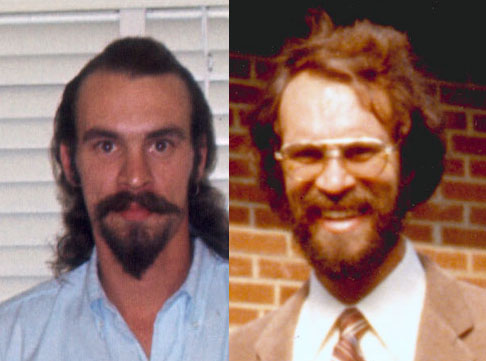 If
you had known me during the period when I was building my chopper, and
you had been asked what was a more likely future for me - a prison
sentence or a PhD in Engineering - you (and I) would almost certainly
have gotten it wrong. This picks up the tale from where the
Chopper Saga left off.
If
you had known me during the period when I was building my chopper, and
you had been asked what was a more likely future for me - a prison
sentence or a PhD in Engineering - you (and I) would almost certainly
have gotten it wrong. This picks up the tale from where the
Chopper Saga left off.When I had first envisioned my dream of getting 'on the road' with my motorcycle, I had been in the Army and seeking a dream of freedom. I had no close friends and few roots. Five years later, when I finally did realize the dream of packing everything on a motorcycle and leaving, things had changed quite a bit. I had some very close friends with whom I'd spent some wild and turbulent years. And when I left, I was not alone. I had picked up a hitch-hiking girl on my Beemer a few weeks before, and we had been seeing a lot of each other. A day or so before I was to leave I asked her if she wanted to go along, and she did. Pam was a young 18 (or so I thought) but seemed to be much older, although I really did not know her very well.
Arriving in California in the Fall of '73, it was apparent that we'd need a place to live till warmer weather came. I found a job driving a double-trailer semi-truck, hauling tomatoes from the field to the local cannery. It was an interesting glimpse at Factory Farming and migrant workers. That job came to an end at the first frost, which killed the remaining tomato plants. Pam found a job as a waitress at a local restaurant. We located a small, and cheap, house behind a Mexican bar in San Jose (this was when San Jose was still a sleepy little run down town, long before Silicon Valley!)
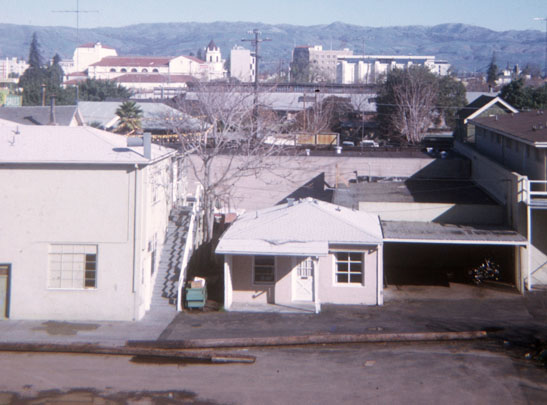
At least it had a carport for the motorcycle, although our front 'yard' was the parking lot for the bar. We furnished it from the nearby Salvation Army and Thrift Shops. The Mexican band in the bar (the big building to the left in the photo) played in the corner of the building closest to our house. Weekend nights our dishes would rattle on the shelves to the beat of the drum, and it would be necessary to sweep a path through the broken glass the next morning before I could ride the motorcycle out.
Once the truck driving job ended, I had a difficult time finding steady employment, and we mostly lived off of Pam's waitress income. I did find the occasional odd job. This was selling Flowers on a street corner for Valentine's day:
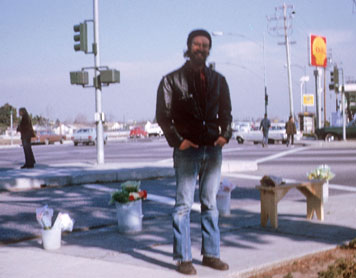
As you may guess, a black leather motorcycle guy is not who you normally think of buying Valentine flowers from, and I didn't make much money that day.
By late winter it was apparent that changes were coming. We had no real plans of our own, and I'd had a bombshell dropped on me. Back in the Fall we had celebrated Pam's 19th birthday. A couple of months later she confessed to me that she wasn't really 19, but had just turned 17! I was floored, as I'd thought the age she had given me before was 'young'. But eventually I reasoned that a number was just that, and we'd been getting along OK so far. But then her mother, who had hired detectives, finally found out where we were. She was talking about coming out to 'get her daughter', and I could tell there was murder in her heart. About this time John ('Squeeze') and Pam ('Pang') came out to visit, and they finally talked us into coming back East to be with our friends. I was pretty concerned about what a Mad Mother might try to do (thinking back to having - unknowingly - taken a 16 yr-old 'runaway' across the border into Canada, just for one...). So, with John, Pam, the preacher and his secretary as the only witnesses, I married for the first time:
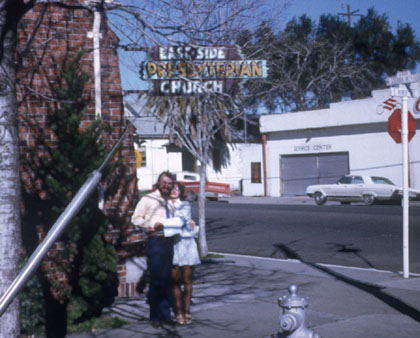
If the preacher noticed he was being inundated with Whiskey Breath, he was kind enough not to say anything. With that little piece of paper for 'protection', it was time to go back and Face The Music.
The next problem was how to get there. I haven't seen these companies listed for many years now, but back then there were a lot of 'auto delivery' services listed in nearly every paper. If you were moving and wanted to get your car transported, you could hire one of these companies to deliver it for you. The company would put ads in the paper looking for a driver from points A to B to deliver the vehicle to it's destination. No pay for the drivers was involved, but you had a car to drive to your destination and the only cost was gas. So if you were yourself looking to get from points A to B, it was a cheap way of doing so. The only car we could find that was a possibility was a tiny Chevy Vega station wagon:
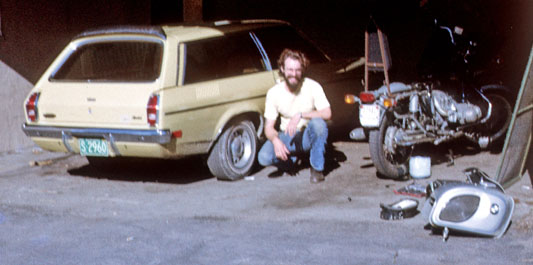
Somehow I managed to fit the entire (disassembled) motorcycle into that car, along with all our meager possessions and a stray cat and dog we had picked up. The cat rode in the passenger's lap, and the dog was at the passenger's feet. We made the very cramped drive back to Virginia in 3 days non-stop.
Back East - 1974
Less than a year before I had left with visions of boundless, if somewhat ill- defined 'freedom' in mind. Now I had had my fill of wandering for awhile, and I had returned, with a wife no less. Before leaving, I had driven trucks for a several years. At first it was a small delivery truck for a construction supply company: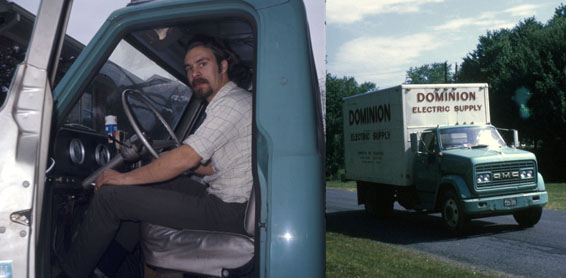
Then in the Fall of '70 I had gone to tractor trailer driving school, and up until my departure the year before ('73) I had hauled gasoline and fuel oil, quite often on the night shift:
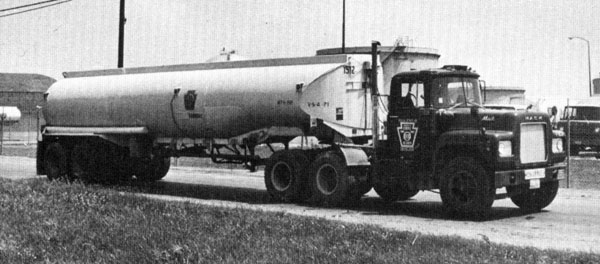
O'Boyle Tank Lines had not paid a very good rate, but they had not cared if I had long hair and looked like a refugee from a Hell's Angel movie, so I had been content. While I enjoyed the freedom of driving a truck, I became nervous about my long term survival after a few years on the job. Every now and then there would be a small, molten pile of slag under a bridge or on an exit ramp, which would be all that was left after someone had made a mistake with one of these rigs. 6 to 8,000 gallons of gasoline or fuel oil can make quite a blaze. Towards the end of those years I was making three 100-mile round trips to a Power Generation station per shift, often at night, hauling fuel oil at high speed down some narrow 2-lane roads. If you recall the Six Days on the Road song from many years ago, it was also often the case that "my eyes were open wide" - not a good combination.
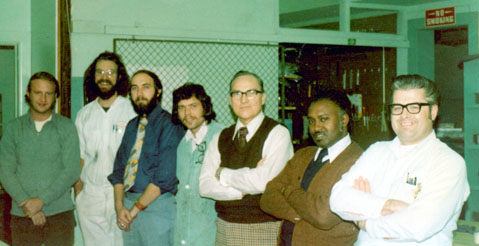
So when we returned I wanted a different line of work. I had done some work as a mechanic before, and I eventually leveraged that experience into a job as a Technician with Atlantic Research Corporation. There I worked with solid propellant rocket motors, making elastomeric insulators and the propellant itself. I believe it was the first 'respectable' job I had ever had:
 After a few rough spots I reached a sort of 'truce' with Pam's mother. I don't
know that she ever really liked me, but we had an amiable enough day-to-day
relationship. At that point we still didn't have our own place to live, but were
staying with John and Pam. As good friends as they were, that began to wear
thin after a month or two. Wanting to go all the way in the direction of this
'respectability' thing, we started looking at houses to buy, rather than rent.
We didn't have much money, but at least I had the VA
Mortgage benefits to back me.
After a few rough spots I reached a sort of 'truce' with Pam's mother. I don't
know that she ever really liked me, but we had an amiable enough day-to-day
relationship. At that point we still didn't have our own place to live, but were
staying with John and Pam. As good friends as they were, that began to wear
thin after a month or two. Wanting to go all the way in the direction of this
'respectability' thing, we started looking at houses to buy, rather than rent.
We didn't have much money, but at least I had the VA
Mortgage benefits to back me.As it turns out, every house I have ever bought so far has been a 'fixer upper'. They have all had 3 defining characteristics:
- The asking price has been far below the value of any other house in the neighbor hood.
- Considerable work was required to simply make the house habitable enough to move in - replacing broken glass, cleanup, etc.
- Well meaning friends have had reactions such as "are you out of your mind!?!?"
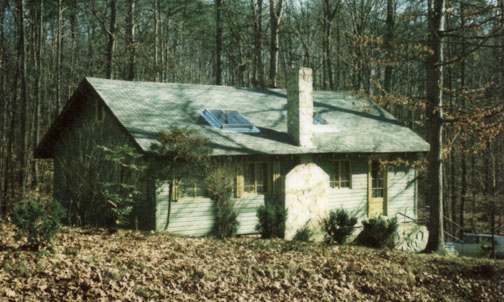 The photo above shows the house after several years of work. Many, many repairs
have been made, and it has a fresh coat of paint. Sections of the foundation in
the basement had been collapsing, leaving a noticeable sag in the roof line.
This picture is after I had jacked up the house and rebuilt the foundation again
- the roof line has been restored to nearly straight. I had left behind dreams
of The Road and was content exploring new, more settled futures.
The photo above shows the house after several years of work. Many, many repairs
have been made, and it has a fresh coat of paint. Sections of the foundation in
the basement had been collapsing, leaving a noticeable sag in the roof line.
This picture is after I had jacked up the house and rebuilt the foundation again
- the roof line has been restored to nearly straight. I had left behind dreams
of The Road and was content exploring new, more settled futures.Atlantic Research Corporation was my first exposure to the Engineering profession. As a Technician I often worked to implement designs a young engineer had drawn up, so I had frequent contact. And at that low level of engineering, my mechanical background was nearly as useful as their engineering degrees, so there was a good deal of back and forth. It really opened my eyes to new ways of thinking - I strongly felt I could do that job - all I needed was the "piece of paper".
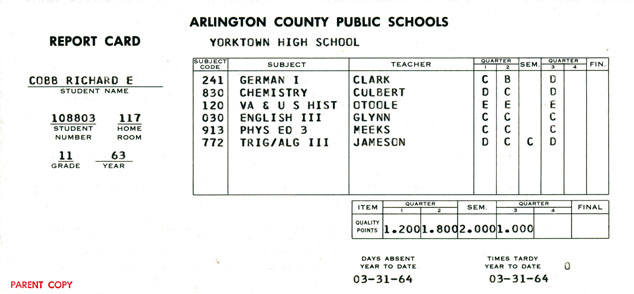
Now, I had never thought much about going to college. Although my grandfather had been educated in Germany, I never knew that part of him since he died while I was young. And no one else in my family had been to college, so it was not something I had ever considered as an option. It was also a daunting prospect - although I had done OK in the earlier grades, by the time I reached high school I was on the low end of things. I had taken to hanging out with the Bad Boys, and academic achievement was not highly valued. In fact I left high school (I'm not sure I'd call it "Graduated" - they did give me a diploma, but I think it was the easiest way they had to get rid of me) with a GPA of 1.8 (4.0 scale). This was one of my report cards from that time:
 So, even though the idea of being an Engineer was appealing, and seemed
'possible' on one level, it was not something I found easy to seriously
consider. I guess the thought was working in the back of my mind though. One
day, in Spring of '75, I picked up the phone to VA and inquired what I could
expect from the GI Bill Education benefits. I also called the local, 2 year
"Community College" to find out what their tuition rates were. Comparing
numbers, I concluded it would be very tight living, but not out of the realm of
possibility. I can't say I ever gave the idea a lot of deep thought, it just
took on a life of it's own and dragged me along with it. I believe it was about
a week from the first call to VA that I was filling out the enrollment
application for the Fall Quarter. On the one hand, I was scared to death - it
was 10 years since I'd left high school, and all I could remember about
Trigonometry was that it had something to do with triangles - and here I was
planning to enroll in a math intensive curriculum. On the other hand, it seemed
like another Grand Adventure, and it seldom takes much to talk me into one of
those! I reasoned that, after all the bad jobs I'd had, not to mention Viet
Nam, I ought to be able to "hang on" for two
years no matter how hard it was.
So, even though the idea of being an Engineer was appealing, and seemed
'possible' on one level, it was not something I found easy to seriously
consider. I guess the thought was working in the back of my mind though. One
day, in Spring of '75, I picked up the phone to VA and inquired what I could
expect from the GI Bill Education benefits. I also called the local, 2 year
"Community College" to find out what their tuition rates were. Comparing
numbers, I concluded it would be very tight living, but not out of the realm of
possibility. I can't say I ever gave the idea a lot of deep thought, it just
took on a life of it's own and dragged me along with it. I believe it was about
a week from the first call to VA that I was filling out the enrollment
application for the Fall Quarter. On the one hand, I was scared to death - it
was 10 years since I'd left high school, and all I could remember about
Trigonometry was that it had something to do with triangles - and here I was
planning to enroll in a math intensive curriculum. On the other hand, it seemed
like another Grand Adventure, and it seldom takes much to talk me into one of
those! I reasoned that, after all the bad jobs I'd had, not to mention Viet
Nam, I ought to be able to "hang on" for two
years no matter how hard it was.The community college system is forgiving in that they will give you a chance if you have a high school diploma or even a GED, and so I learned that I had been accepted in a relatively short time. A little later that Spring I was on my way to work on the motorcycle one morning. The sun was at my back, and a car coming from the opposite direction had the sun in their face. The driver turned left into a parking lot without ever seeing me. I tried to swerve around behind the car, but ended up collapsing the entire right rear quarter panel on the station wagon. This confirmed something that I had experienced once already in Viet Nam - if you are going to suffer a sudden and violent end, it will be painless. The little I remember of that impact was sort of like hitting a big soft cushion. It was only afterwards, when I regained consciousness lying in the road, that the pain began.
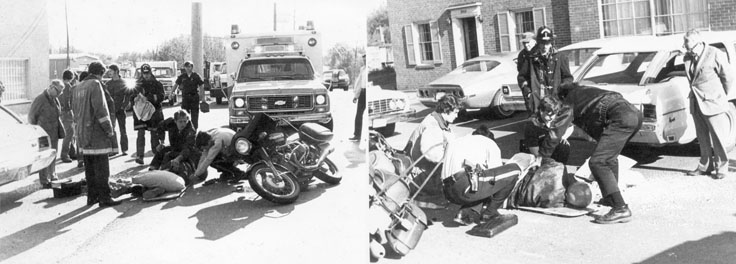
These are the police photos. The driver of the station wagon is looking on from the right edge of the above photo, and the crushed-in side of the station wagon is behind him. I was completely immobilized with pain - there were bulges in my clothes where it made no sense for them to be, and I resolved that nobody was going to move any part of me until I had some kind of pain killer. I learned then that a loud scream was an effective way of communicating what you did not wish to have done. I was gently moved onto a board and eventually onto the X- ray table, all without changing the position of any part of my body. My left hip had been dislocated, a kidney stopped working for a few days, and I had a bunch of broken ribs and a collapsed lung. I spent several days in intensive care.
Because of the dislocated hip (they said I would have been better off to break it than to dislocate it) I spent the next 10 weeks in traction. We eventually went to court, with the driver being charged with failure to yield right of way. His defense was that he had not seen me. He was a local businessman in a small town, and the charges were dropped. His insurance company eventually paid me a few thousand, or that was what I had left after the lawyer took his cut. To put it in perspective though, that was the equivalent of about 3 full years of dorm living and tuition at Virginia Tech at the time, although I knew nothing of either of those then. And that money turned out to be extremely useful for getting us through the next few years of school. But I would not recommend it to others as a means of obtaining financial assistance.
Starting Classes - 1975
Both Pam and I enrolled for the Fall Quarter of 1975. You have 10 years to use up the GI Bill education benefits, and I was down to less than 4 years of that time left, so I could not afford to take extra time with remedial classes - I had to go for it all at once. Intimidated does not begin to describe how I felt as the time to start classes approached. I was heading straight into a 5 credit hour Calculus course, and I barely remembered what Algebra was. I spent a couple of weeks ahead of time in the school library, working my way through every math tutorial and self study course I could find there. On the first day of Calculus, they gave us a quiz to see if we had adequate preparation for the course. I believe the lowest possible score that they recommended even thinking about trying the course was 18 out of 25. Well, guess who got 18... And that was after all that prep work ahead of time. None the less I stayed on.All Nighters were not something I did before tests - it became a way of life for those first few quarters. I could not bear the thought of failing - if I could only get C's I would be happy! At the end of that first quarter it was with great dread that I went around to look at the grades as they were posted. I could not believe my eyes - in class after class I had gotten an 'A'! I had a perfect 4.0 that first quarter - something I had never imagined! After that the (self-imposed) pressure was on. If I ever got a B, I would never be able to go back to a (cumulative) 4.0 again. Which was OK, but every time I would hit exhaustion before a test or assignment, I would always ask myself this question: if you lose the 4.0 because you stopped right now, how will you feel about it later? And I knew there was some threshold at which I would say it didn't matter - I had done all I could do. And I did reach those points, but apparently only after I had done enough. But if I had not gotten that 4.0 the first quarter, I would never have pushed myself nearly as hard afterwards.
That Fall the Calculus course had started with two full classes of about 30 students each. By the Spring quarter there were five of us left from those two starting classes, and I received the only A at the end of the year. When I first enrolled, I had thought only in terms of surviving a two year degree - as if it would be a tremendous ordeal. Instead I found myself swept up as I could never have imagined - I loved what I was doing!
I had always loved mechanical things, and would take small engines apart as a kid and then have great delight in getting them running again after putting them back together. But there had always been a piece of that missing for me - as I held, say, a connecting rod in my hand, it would always fill me with wonder how someone could know enough to design it so that it could take those high loads and not fail, and yet be as light as it was. It seemed like magic. And now, in my classes, the magic veil was being swept away, and I was being given a great shiny toolbox of knowledge that would allow me to know those things too!
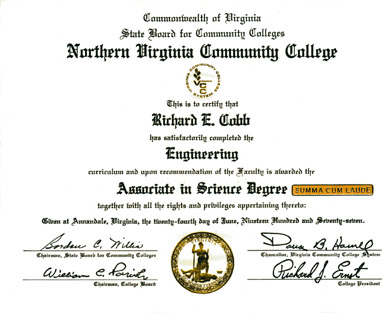
I kept that 4.0 all the way through the two year degree, which gave me the credentials I needed to transfer to the Big School - Virginia Tech - for the coming year. By then there was no question that I would continue on for the four year degree - I would have been heart broken to have had to stop then. I had my first "piece of paper", and I wanted more!
The Big School - 1977
At that point Pam, who had also received a degree, had had enough of college. She found a job in carpet sales and it was decided that she would stay at home and support the house, while I would use my GI Bill benefits to support myself at Virginia Tech. So, in 1977, at the age of 30, I moved into a Dormitory on the VT campus.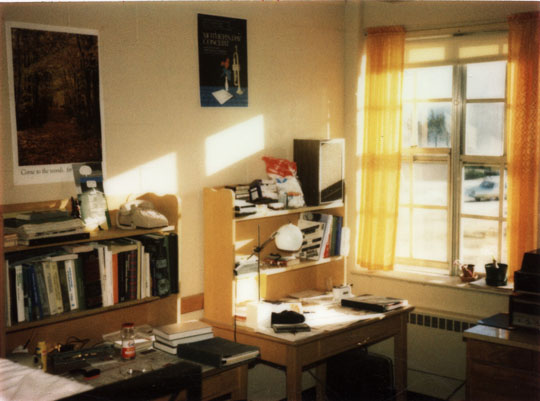
I was at least 10 years older than most of the kids there, but that didn't bother me. Loud parties were no big deal - I had gotten all that out of my system, and I had ear plugs if I needed them. And although I had a young room mate, he was gone most of the time. I heard many people complain about the food in the dining halls, but I never understood that. They obviously had no idea what Army chow was like! This was far better than that, and all you had to do to get fed was show up! That was luxury! No shopping, meals to cook, or dishes to wash, I could spend all my time in studies.
Which I did. I was intimidated all over again. Sure, I had gotten the 4.0 in the small school, but I heard the often not-so-subtle condescension about how "things are different here". So I went at it full throttle all over again - wanting to prove myself in the new environment.
Many weekends I went back home, but on many others I stayed in town when the work load was too high to justify the travel time. And on one of those weekends, in the Spring of '78, I discovered caves and caving. My first trip was typical - flash lights, no helmets or other proper gear, and I became lost. Fortunately it was a popular cave, and I found others to guide me out. From that I learned that caving was something I really wanted to do, but that I would have to learn more about it. I heard there was a Cave Club on campus, and resolved to check them out. But I did not get a chance during that school year.
I signed up for my second (Senior) year in the Dorm, but this time I decided I wanted a little more control over my environment, and applied to become an RA (Resident Advisor). I was accepted, and what followed was one of the very rewarding experiences of my life. I was old enough that the kids did not feel the need to challenge me as they might have someone closer to their age. And I, in turn, enjoyed them greatly. We had our rules - nothing gets broken, clean up your own puke, etc - but beyond those they were free to have a good time. And when I had time, I would join in with them.
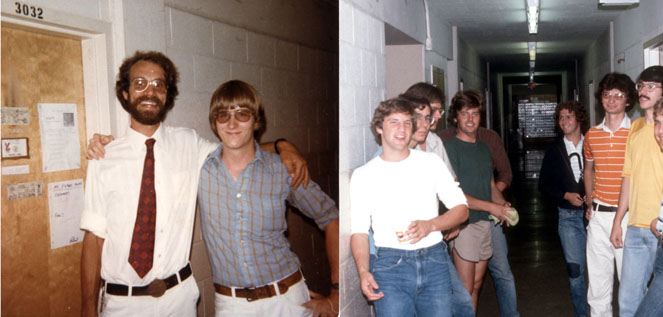
Kegs were not allowed in the dorm, but every so often some of the guys would show up at my door with a pitcher of beer for me. "Oh, we just filled this up out of beer cans." And I would know whose room not to check or go into in the near future!
That Fall I did look up the VT Cave Club, and it was the beginning of a life long relationship. I found very competent people who also knew how to have a very good time! I felt a great affinity for this group, and threw myself into caving every chance I got. Although I had no idea at the time, the cavers would eventually become my new "family".
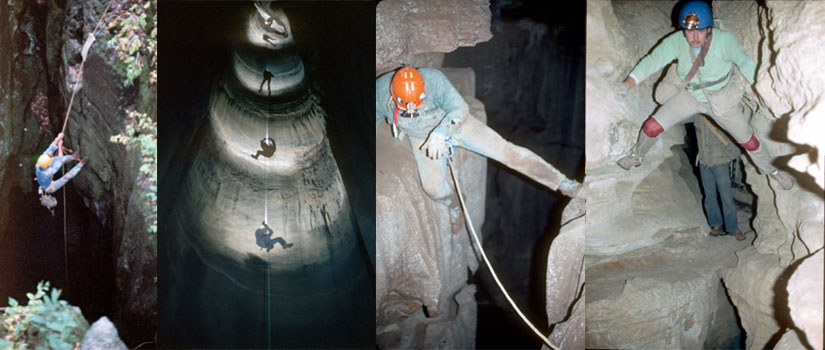
This was an organization with heavy alumni involvement, and members from 10 or 15 years previous were still going caving and attending club functions. Many of these alumni had gone on to explore at the fore front of the sport, and some were known as pioneers throughout the greater caving community. I was the same age as many of the alumni, and we bonded easily. Finding the caver group came at a very fortunate time, as it was becoming obvious that my marriage was hitting some rough spots from which recovery seemed unlikely.
1979
1979 was one of those years that I will remember for the rest of my life. I was having a great time with my Dorm Guys - this was after I took them on a Hall caving trip into a local cave.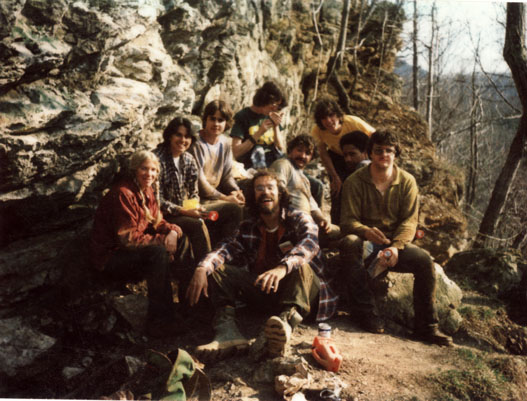
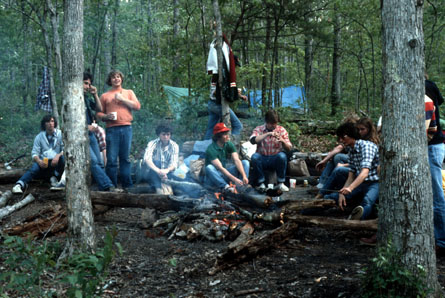
We also went out hiking and rappelling on the local cliffs. And we had one final end-of-year party out on the mountainside in the Spring. Instead of dealing with all the picky Dorm rules, we simply loaded up some kegs and camping gear and headed out into the woods. That was a fun, all night party with "my kids":
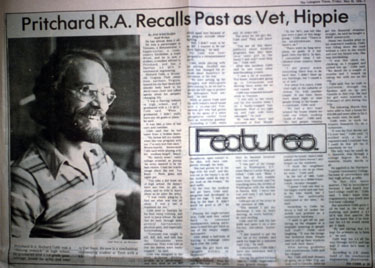
As an "old" Viet Nam veteran living in the Dorm (I had just turned 32), I attracted the attention of the school newspaper, which published an article in the Spring of '79:
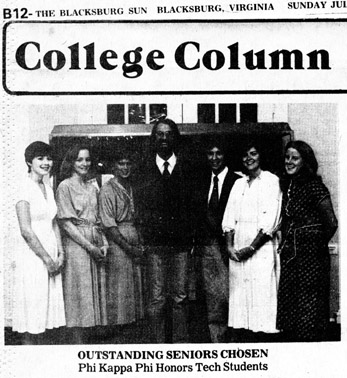
On top of it all, I had managed to hold on to my 4.0 GPA all the way through my two years at the "Big School", and graduated at the top of the College of Engineering;
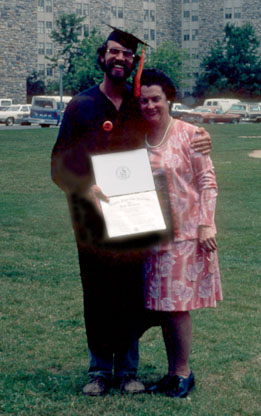
A proud mother and son, as I got my second "piece of paper".
It was a year that was a culmination of a transformation that had taken me, and everything I had thought I had ever known, completely apart and put me back together in ways that I was still trying to figure out. The old "Hoss" of the Chopper Days might just as well have been some other guy, many lifetimes ago.
And with all the other honors and changes I experienced that year, I have not yet mentioned one of the real highlights for me: I was voted into membership of the Cave Club, and shortly afterward as the Vice President - a position that was primarily responsible for training new Prospective Members in safety and techniques. I had not known Bill, the new President, before the elections, but we hit it off immediately. I was delighted with the training role, and Bill had the energy, enthusiasm, and personality to attract new members. Working enthusiastically together we were able to do far more than just the sum of our efforts. It was a Highlight Year for both of us, and the basis of a friendship that continues to this day:
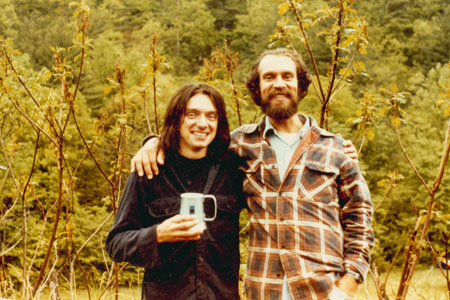
This was Bill and I greeting the dawn in the aftermath of an all night party in which neither one of us had gone to bed.
With all the ups, there were also the lows. My divorce became final one Friday in the Fall, and Pam remarried the next day.
But by that time I was busy with the Cave Club Training Program, and had also started Graduate School. I had been offered a Fellowship and a Teaching Assistant position, both of which I accepted. It wasn't a lot of money, but more than comfortable for my needs at the time. I was learning about teaching, not only with the Cave Club, but also in Engineering.
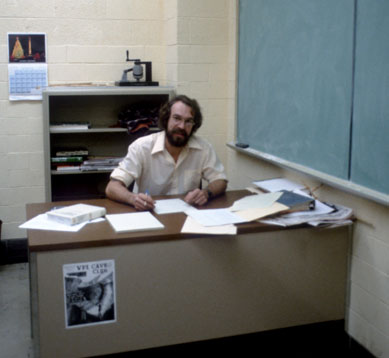
GTA's (Graduate Teaching Assistants) normally only run Laboratory classes, but I expressed an interest in trying more than that, and I was given the opportunity. By my second (and final) year of the Master's program I was teaching full Junior level Engineering courses. I was learning that the role of teacher is one that suits me very well.
The time of my Master's studies was mostly a quiet time in which I was coming to terms with the new person I was becoming, and actively involved in my studies, teaching, and caving. One very fateful event did happen in my second year. In January of '81 I took my first hang gliding lesson.
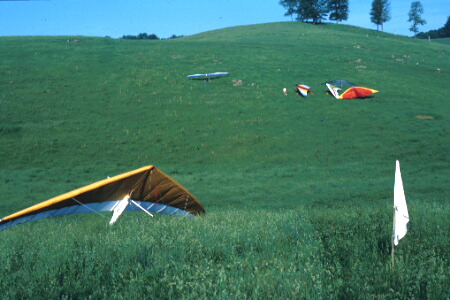
As a beginner you only make very short flights off of small hills, but I was hooked. My life would never be quite the same after that. Most of the rest of this website is devoted to flying, so I won't go into that here, other than to say I had found a new passion that lives till this day.
1981
I completed my Master's Degree in the Summer of '81. While I had an offer to continue studies to earn a PhD, I felt it was time to go out into the world and try out what I had learned so far. I loved going to school, but I did not want to 'use it up' if I wasn't completely into it. I found a job with a DuPont plant in North Carolina. I moved to North Carolina, and was married for the second time, in August of '81. While this marriage also did not last, it did make it a lot longer than the first one.The Brevard, North Carolina DuPont plant, which manufactured X-ray film for medical uses, was located in an idyllic setting in the mountains adjacent to the Great Smoky Mt National Park.
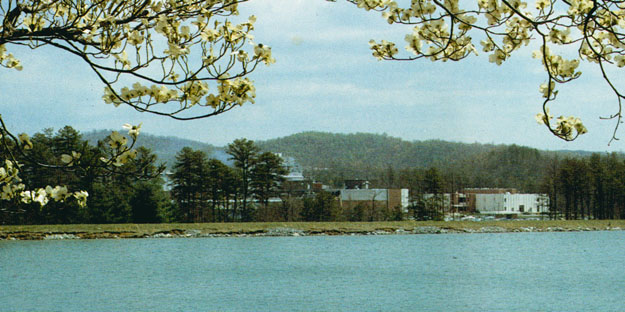
My commute to and from work was through mountains and scenery that many people only see on vacation. My new wife and I spent two years there, as I settled into the routines of seeing the Engineering profession from 'the other side of the fence' than had been the case back at Atlantic Research. I enjoyed the job, and the people I worked with, but it was a manufacturing plant, which meant that almost all the engineering was directed towards maintenance and process improvement. It was certainly interesting and challenging enough for a new engineer, but I could also see that the potential for growth there was limited.
During those 2 years I had regular contact with the head of the Mechanical Engineering Department at Virginia Tech, Prof. JB Jones. He would call once or twice a year to make offers to entice me back to Graduate School. After two years at DuPont, I took him up on a very generous offer.
1983
In the Fall of '83 I returned to Virginia Tech as a full time Instructor (bottom end of the faculty ranks) and a part time PhD student. In terms of a job, the next five years were some of the most enjoyable of my life. I had almost all the privileges of a faculty position, but without many of the responsibilities (such as seeking grants). And I loved being in the classroom, in both teaching and student roles. I feel it was here that I really learned what I had been exposed to in the previous 6 years of classes. By seeing a subject one time in a class you can only gain a minimal understanding - it is repeatedly teaching that subject to others that you actually begin to understand, and retain, that knowledge.I was fortunate to be able to have a renowned Professor and all around great guy as the head of my Graduate Committee: Prof. Larry Mitchell.
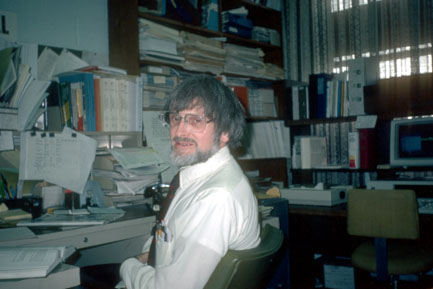
Larry was well known in the field of Vibration, particularly in experimental measurement of complex structural vibrations. I gravitated towards the experimental end of things, as it fit in well with my previous 'hands on' experience.
When I was not teaching I spent most of my time in research and the Modal Testing Laboratory:
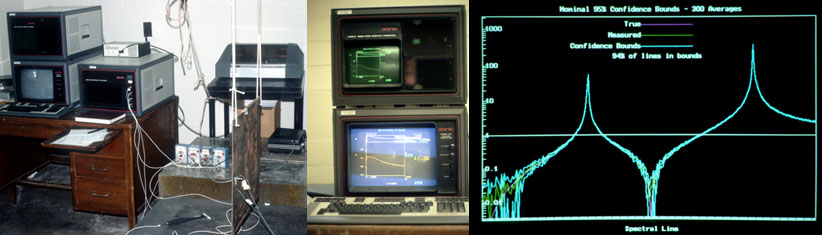
In whatever time I could spare, I also earned my United States Hang Gliding Association Instructor rating, and had a regular group of students that I would take to the "training hill".
1988
In 1988 I passed the Final Examination and had my Dissertation approved, and thereby earned my PhD. It had been 15 years since "Hoss" had ridden into California, seeking shelter for the Winter. The experiences of the intervening 15 years had completely reshaped me. I had found more challenges, excitement, adventure and fulfillment than I could ever have found 'on the road'. I still shake my head in a sense of wonder that things turned out the way they did. It would have been so easy to have not made that phone call to the VA, or have made it but not followed through. I can't even begin to guess where my life would be now if I hadn't.There is one thing that disturbs me as I look at the world today, and particularly in the US. I know that social programs can cause as many problems as they cure, and that government expenditures cannot be expected to solve everything. But I also know that when I was in my under-graduate studies that the educational institutions were much more heavily subsidized, with corresponding lower tuition rates. And while we were attending the Community College we made use of Food Stamps and every other bit of assistance we could find. And I am, today, profoundly grateful for every bit of that assistance - it was what made this whole adventure possible. I also feel the higher taxes I am now paying, as a result of what that assistance made it possible for me to do, have made that assistance a good investment for the government.
I try to imagine myself being 30 years younger in today's world, and making that same call to the VA. I think I would have added up the numbers on both sides of things and found it to be just too daunting to attempt. Which is not to say that it could not be done, but higher barriers mean fewer opportunities to raise yourself to the next level. And, as happy as I am that things worked out for me as they did, I am sad to think that there are probably others today who would like to do what I did, but not be able to see their way. I strongly believe that investment in education is one we cannot afford to scrimp on.